

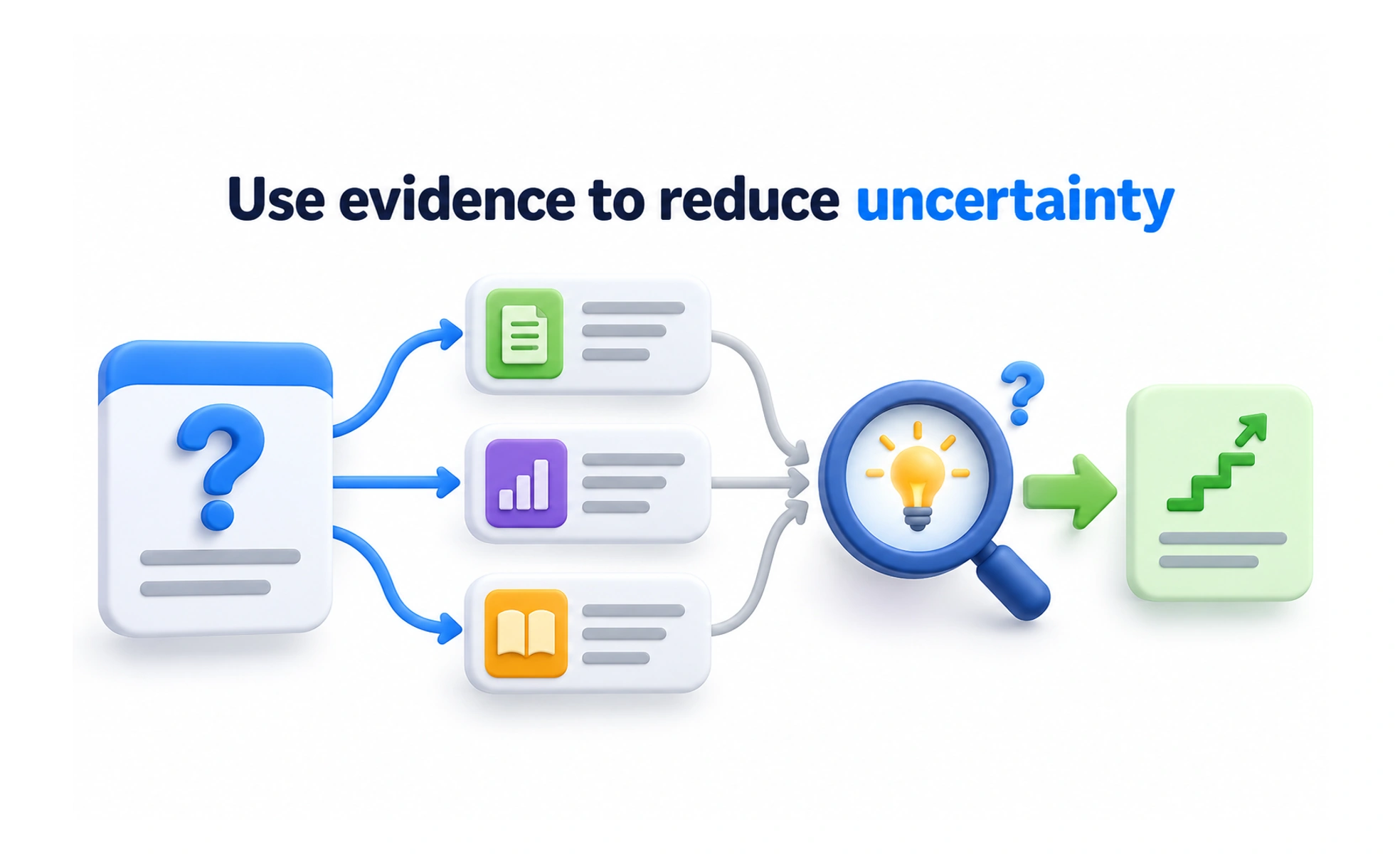
Research can investigate people, markets, systems, or existing evidence. Good research makes its question, method, sources, and limitations visible so readers can judge how much confidence to place in a conclusion.
A navigator compares landmarks, maps, and conditions before choosing a route. Research similarly combines relevant sources rather than relying on one convenient clue.
Turn curiosity into a question
A useful research question is specific enough to guide evidence gathering and open enough to allow an unexpected answer. It should connect to a decision or knowledge gap. Questions that assume a preferred answer tend to produce confirmation rather than learning.
Assess source quality
Consider who created a source, why it exists, when it was produced, and what evidence supports it. A survey, interview, analytics report, and published article each have different strengths and limitations. Cross-check important claims with independent evidence where possible.
Separate evidence from interpretation
Record what was directly observed or measured, then explain the interpretation and remaining uncertainty. This distinction makes it easier for others to challenge an assumption without dismissing the underlying evidence.
Communicate findings responsibly
Share methods, relevant context, caveats, and implications in a form people can use. Avoid making broad claims from narrow samples or hiding evidence that conflicts with a conclusion. Good research helps a decision; it does not guarantee one correct answer.
Frequently asked questions
Key takeaways
- Ask a focused question connected to a real knowledge gap.
- Evaluate sources by origin, purpose, date, and supporting evidence.
- Distinguish observation from interpretation.
- Communicate limitations as well as implications.