

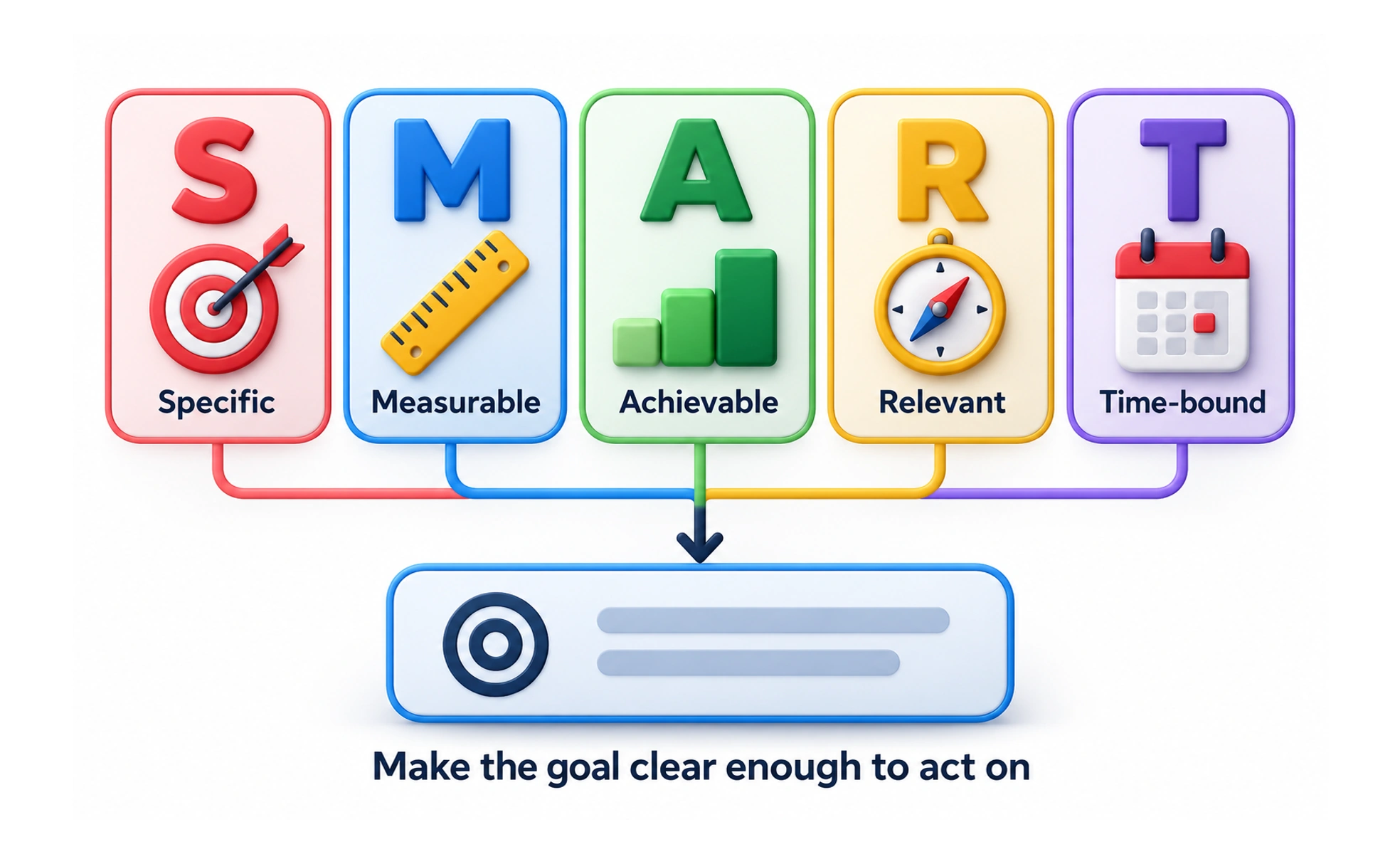
It prevents vague wishful thinking by establishing unambiguous criteria for success and completion. In product management and design, it ensures roadmap commitments remain grounded and accountable.
Think of it like this. Saying 'I want to get fit' is a vague dream. Saying 'I will run five kilometres in under twenty-five minutes by December first' is a SMART goal.
How it works
The SMART framework evaluates any proposed goal against five rigorous criteria.
- Specific states clear, unambiguous outcomes answering what needs to be accomplished and who is responsible.
- Measurable defines concrete metrics that provide verifiable evidence of progress and completion.
- Achievable ensures the target stretches capabilities while remaining realistic within available team resources.
- Relevant aligns the goal with broader team strategy, customer needs and current business priorities.
- Time-bound establishes a firm deadline that creates a healthy sense of urgency and milestone pacing.
When to use it
Apply SMART criteria whenever ambiguity threatens project delivery or team alignment.
- Defining project milestones ensures designers and developers understand exact release expectations.
- Performance development plans sets clear, objective skill improvement targets for junior designers.
- Usability benchmarking specifies exact task completion targets before starting redesign initiatives.
- Client contract scopes establishes testable deliverables that prevent scope creep and disputes.
Trade-offs
SMART goals provide exceptional operational clarity, but can sometimes restrict creative discovery.
- Discourages moonshot innovation because the Achievable criterion biases teams toward safe, incremental bets.
- Over-focus on easily measured metrics can divert attention from qualitative, hard-to-measure design subtleties.
- Requires administrative overhead to define, debate and calibrate metrics across multiple stakeholders.
Frequently asked questions
Key takeaways
- SMART goals enforce five criteria: Specific, Measurable, Achievable, Relevant and Time-bound.
- Clear deadlines and quantitative metrics remove subjective debate over whether a goal was met.
- They transform vague aspirational wishes into concrete, actionable execution plans.
- Balance SMART execution goals with open-ended exploratory design research.