

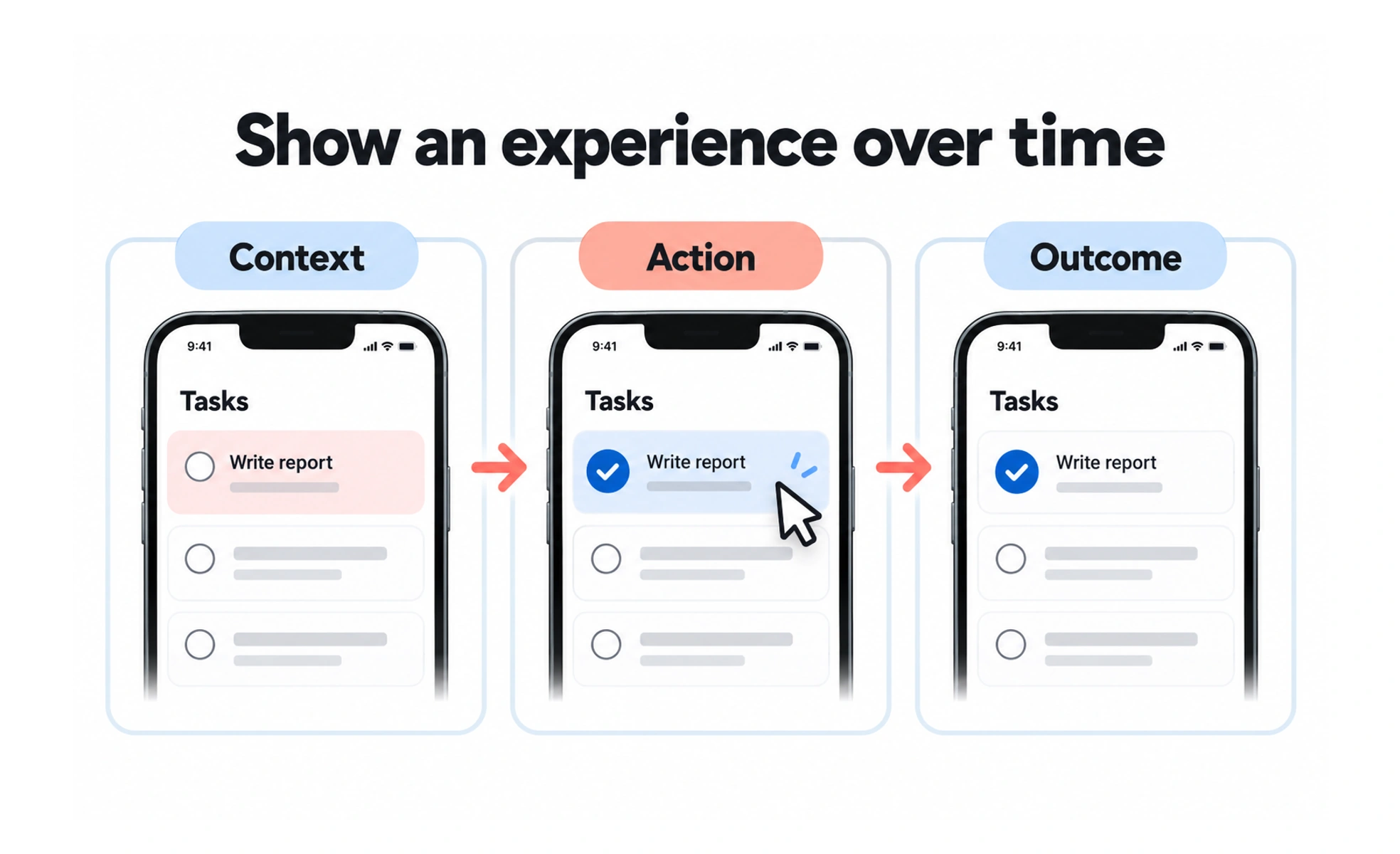
In product design, it helps people discuss the situation around an interaction. A drawing can show where someone is, what they are trying to achieve and why the product matters at that moment. Artistic skill is less important than a clear, believable sequence.
Choose one situation to explain
Start with a specific person, goal and event. “Using our app” is too vague. “A commuter discovers their usual train is cancelled” gives the story a useful starting point.
Decide whether you are communicating research or proposing a future experience. Label the distinction. A convincing drawing of a proposed service does not make it an observed customer story.
Show the context between screens
Use a small number of scenes with enough detail to understand the experience. Include the environment or another person when it affects the decision.
Keep captions focused on what changes in each scene. Avoid placing a long feature description beneath a sketch. If every panel is just another screen, consider whether a wireflow would communicate the work more clearly.
Example: a cancelled train
The first scene shows a commuter approaching the station. The second shows them learning about the cancellation. The third shows a proposed alert explaining the next available options, and the final scene shows them choosing an alternative route.
The team notices a missing condition: the person may already be on the platform with a weak connection. It can now investigate how the proposed service handles that context before investing in polished screens.
Use the story to expose assumptions
Invite colleagues or relevant participants to question the sequence.
- Does the person have the information shown?
- Is the timing plausible?
- What could interrupt the experience?
- Does the ending solve the original problem?
Revise the story when those questions reveal gaps. A storyboard supports discussion; it is not evidence that the proposed experience will work.
Frequently asked questions
Key takeaways
- Tell one specific experience in a clear sequence.
- Show context that screens alone cannot explain.
- Label research-based stories and future proposals differently.
- Use questions to expose missing conditions.