

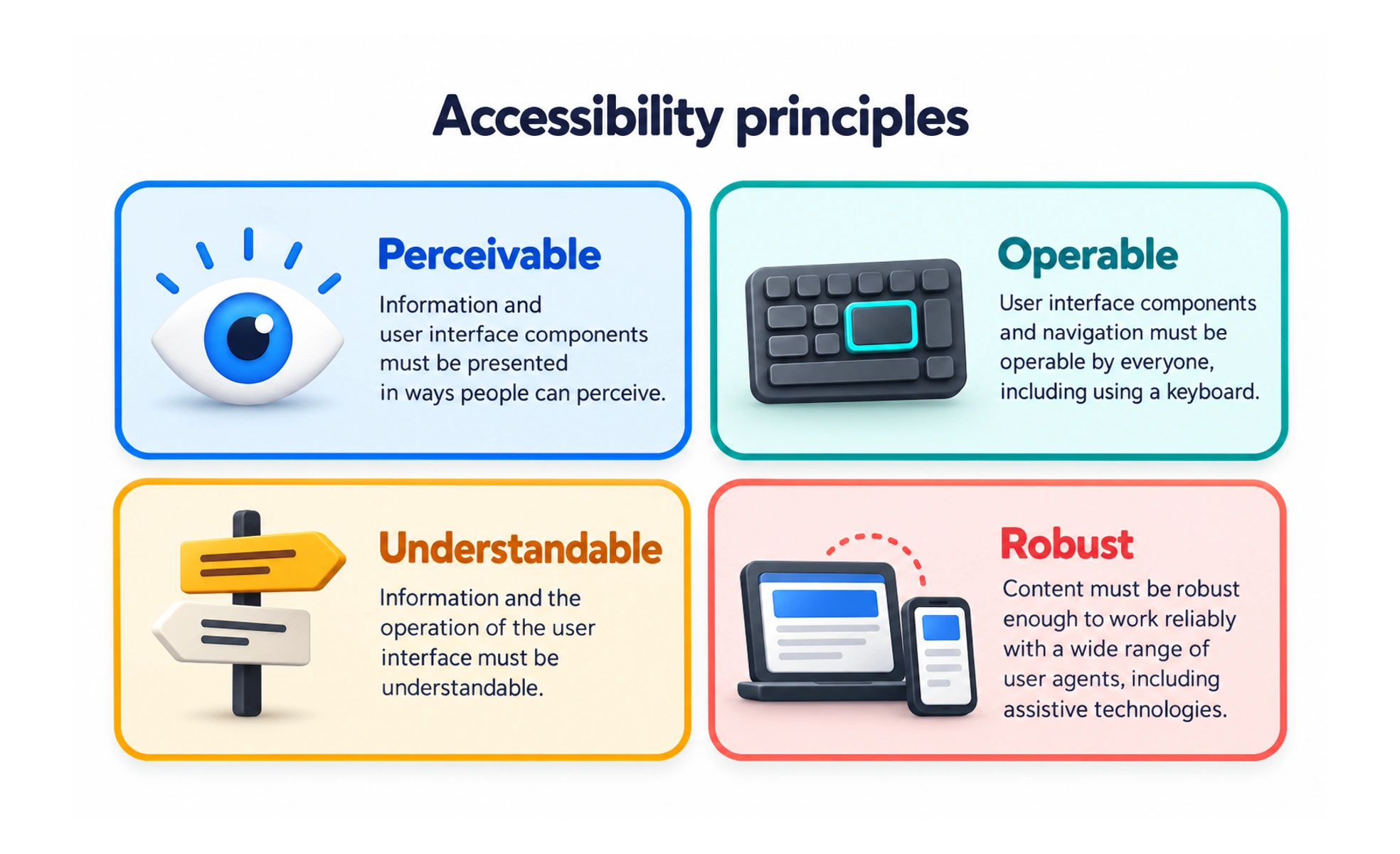
The Web Content Accessibility Guidelines are a W3C standard for making web content more accessible to people with disabilities. They provide testable criteria that help teams evaluate important aspects of an experience.
A building access standard describes requirements for usable entrances and routes. WCAG provides a shared reference for checking access to digital content and functionality.
Use a defined version and level
State which WCAG version and conformance level the project targets. The guidelines contain success criteria organized under principles concerning perception, operation, understanding, and compatibility. A clear target gives designers, developers, and reviewers a common basis for discussing what must be checked.
Apply criteria across the journey
Consider complete processes and relevant states, including errors, dialogs, loading, and authentication. A page can look accessible while a later step prevents someone from completing the task. Shared components help, but the way they are composed and populated also affects accessibility.
Combine tools and human evaluation
Automated checks can detect some issues, while keyboard use, assistive technology, and manual review reveal others. Include people with disabilities in research where appropriate. Passing an automated scan alone does not establish conformance or prove that the experience meets every user need.
Example: a quiz
A quiz needs understandable questions, labeled choices, visible keyboard focus, and feedback that can be perceived without color alone. Timing and error recovery also deserve review. Check the complete attempt and result flow, then record the criteria and conditions actually evaluated.
Frequently asked questions
Key takeaways
- Specify the WCAG version and conformance target.
- Evaluate complete journeys and meaningful states.
- Combine automated checks with manual evaluation.
- Treat accessibility as continuing product work.