

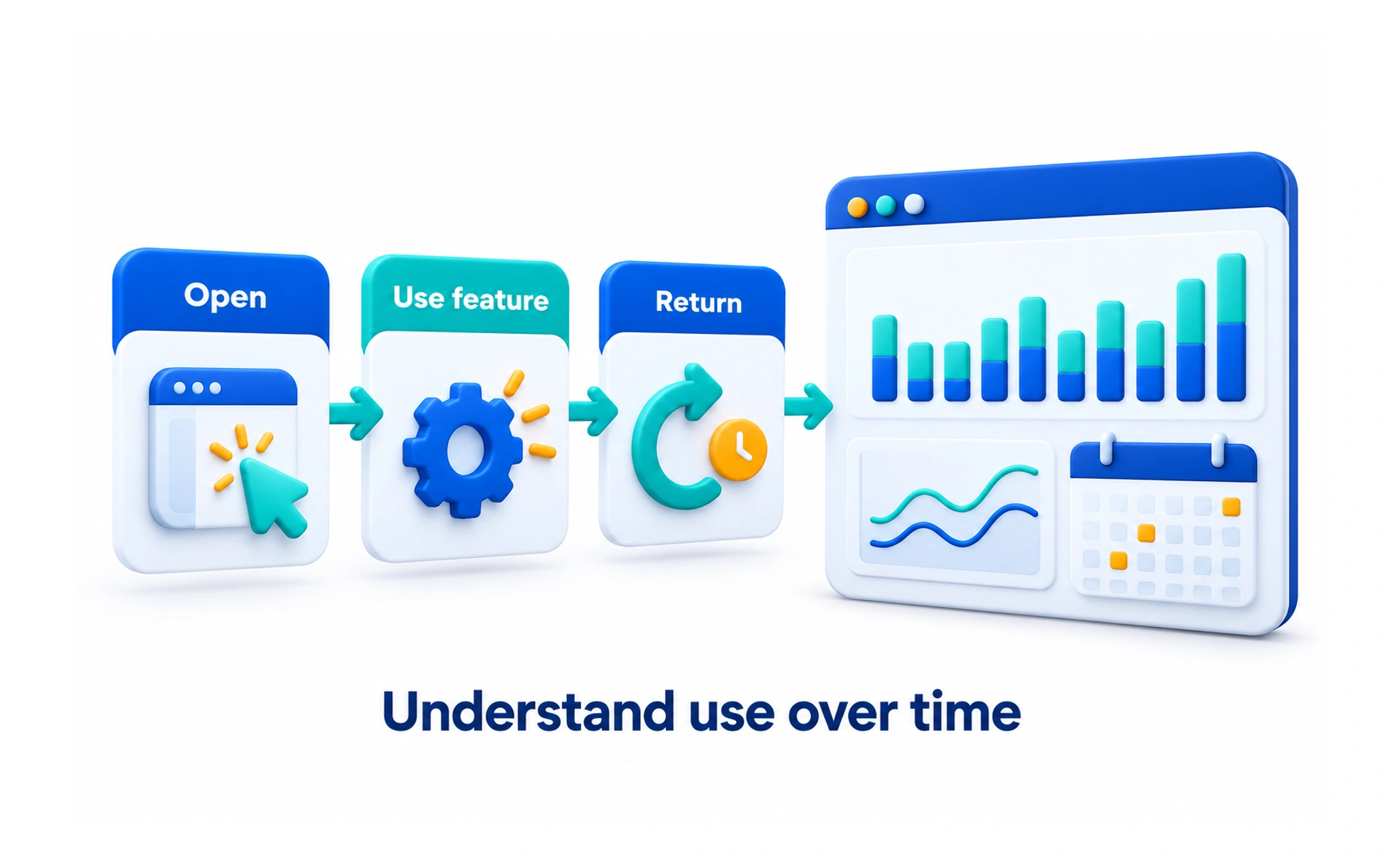
Product usage analytics examines how people use a product and its capabilities over time. It helps teams understand adoption, repeated value, and changes in behavior across groups.
A library learns more from patterns of borrowing and returning than from counting visitors at the door alone. Product usage also needs context about meaningful activity.
Define useful activity
Decide which actions indicate that someone received value. Opening a page may be relevant, but it is different from completing a lesson or collaborating on a real plan. Use a definition suited to the product and its natural usage frequency rather than treating every session as equally meaningful.
Build a dependable event model
Give events consistent names and document properties, identities, and completion conditions. Avoid collecting sensitive information that is unnecessary for analysis. Review instrumentation when behavior changes so event counts do not shift simply because an implementation began sending duplicates.
Compare cohorts and contexts
Group people by a meaningful shared starting point, such as signup month or first successful task, and observe later behavior. Segment only when the group is large enough and the comparison serves a question. Different acquisition sources and use cases may explain different patterns.
Example: a new recommendation feature
A team can examine how often eligible learners see recommendations, choose one, and complete useful learning afterward. Separate exposure from engagement and downstream value. If only enthusiastic learners choose the feature, their higher retention alone does not prove that the feature caused it.
Frequently asked questions
Key takeaways
- Define activity through meaningful product value.
- Maintain consistent event and identity definitions.
- Use cohorts and segments to interpret behavior.
- Avoid treating correlation as proof of causation.