

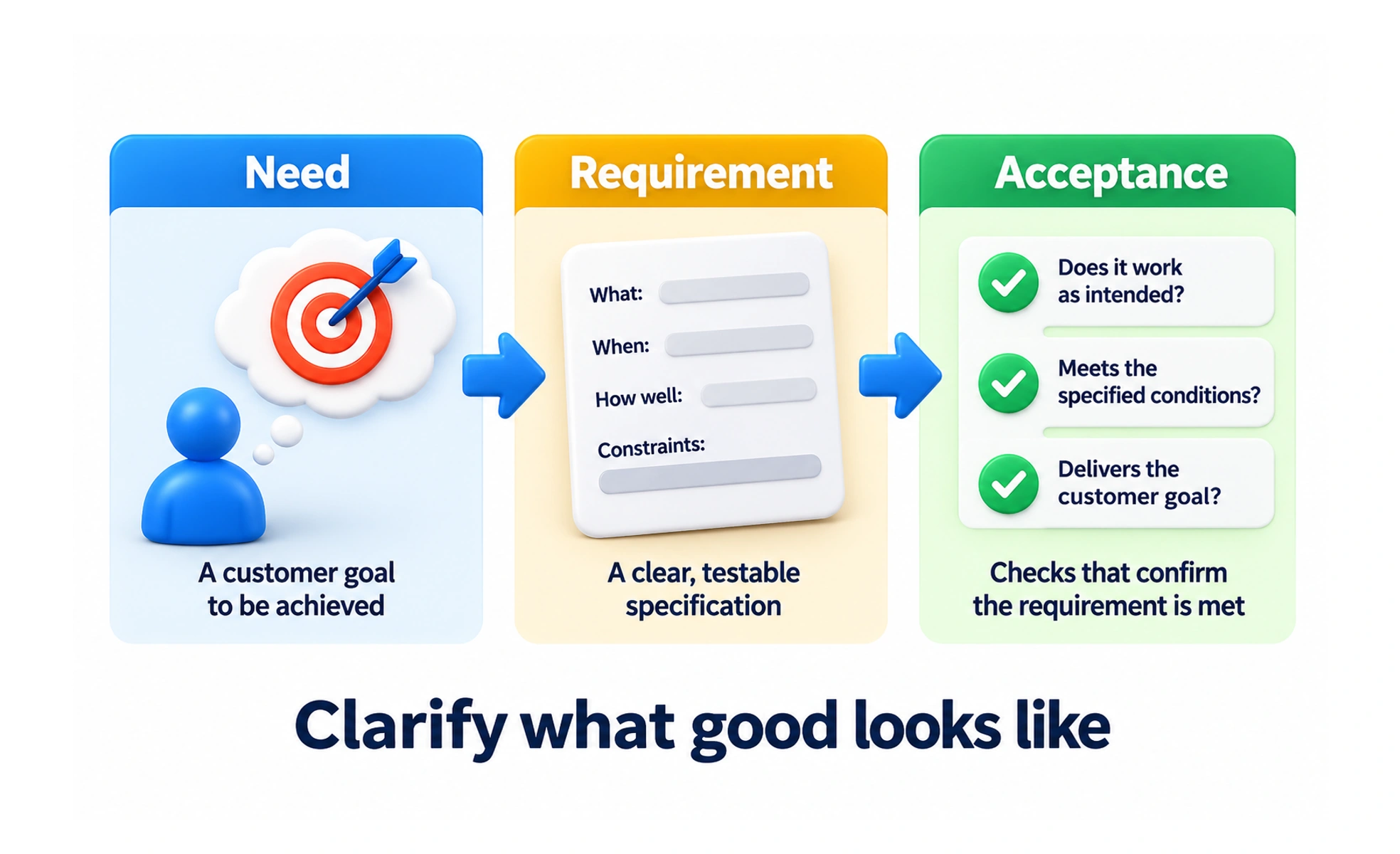
A requirement should help people make and check decisions. “Add a better dashboard” leaves almost everything open. “Let an account owner find and download last month’s invoice” describes an outcome that can be discussed, designed and tested.
Separate the need from a proposed feature
Ask what problem a request is trying to solve. A stakeholder may ask for a chart because they need to spot overdue work. A simpler list with a clear status could meet that need more effectively.
Capture the people involved, the task and the conditions that matter. Keep proposed solutions visible, but do not confuse the first suggestion with the only acceptable implementation.
Make conditions explicit
Discuss behavior beyond the successful path. What if there are no records, the person lacks permission or the network fails? Requirements may also cover accessibility, performance and data handling.
- Describe who may perform the action.
- Define the meaningful inputs and outputs.
- Record relevant constraints and dependencies.
- Agree on observable acceptance conditions.
Replace vague words such as “fast” with an agreed measure when that measure is needed.
Example: downloading an invoice
The team agrees that an owner can choose a billing month and download its invoice. If no invoice exists, the interface explains that rather than returning an empty file. A teammate without billing access cannot download it by changing a link.
These conditions guide design and implementation together. They also reveal questions about invoice creation and account permissions before the team considers the feature finished.
Review requirements as learning changes
Requirements are not a reason to ignore new evidence. Record why a condition changes and what other work it affects.
Keep the detail proportional to risk. A small label change may need a brief acceptance note; a payment workflow needs more explicit rules. The aim is shared understanding, not a long document nobody can use.
Frequently asked questions
Key takeaways
- Describe the user outcome behind a request.
- Include permissions, exceptions and recovery.
- Use acceptance conditions people can observe.
- Update requirements when evidence changes.