

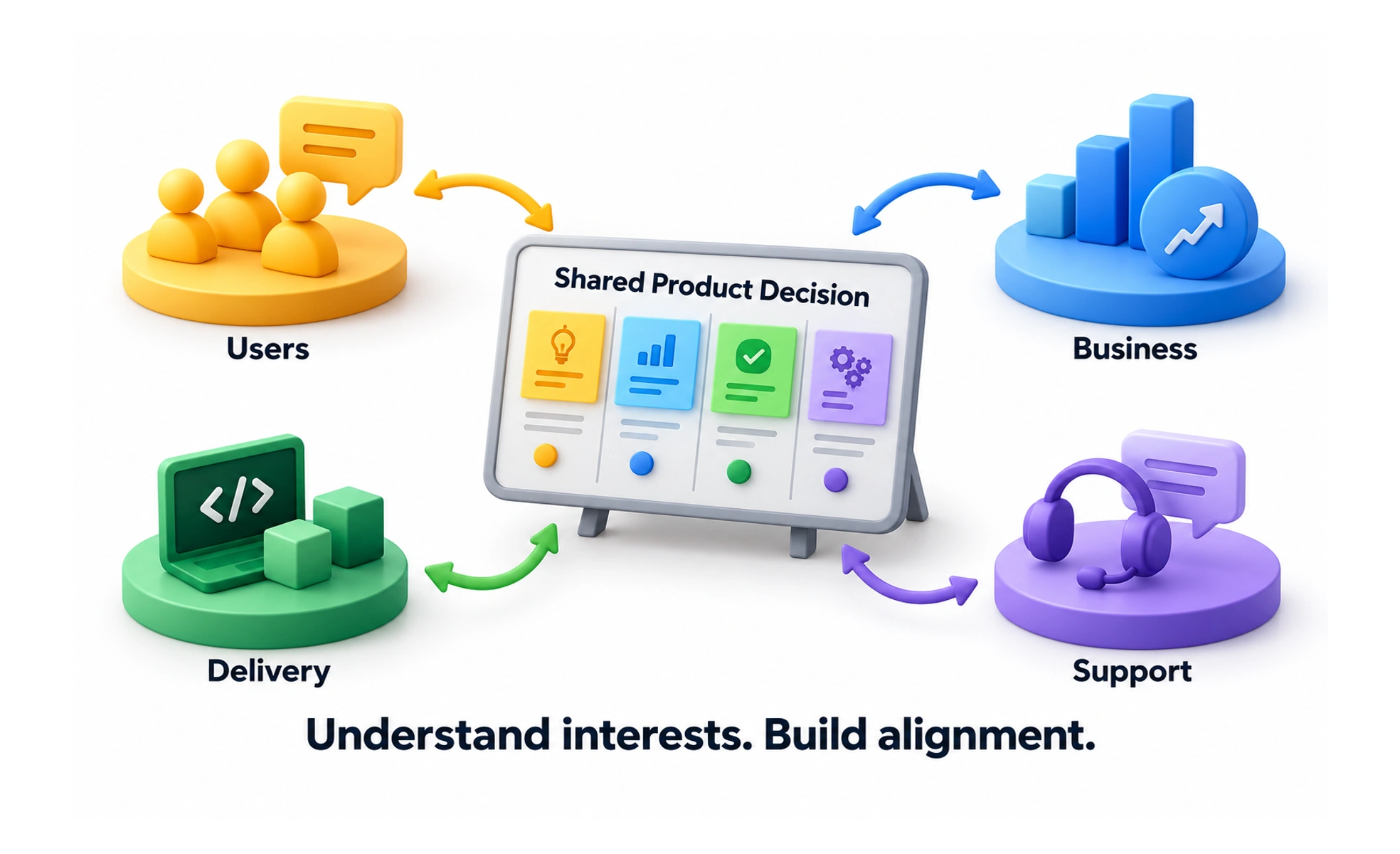
It ensures executives, clients, sales teams and engineering partners understand product decisions and share common expectations. Effective management transforms skeptical organizational leaders into active champions.
Think of it as conducting an orchestra. The conductor must balance the volume and tempo of brass, strings and percussion so they perform a harmonious symphony rather than competing noise.
How it works
Stakeholder management operates as a structured communication and alignment discipline.
- Stakeholder mapping plots interested parties on a power-interest grid to determine appropriate communication cadences.
- Empathy interviews uncover hidden political incentives, risk fears and commercial pressures driving stakeholder demands.
- Collaborative co-design workshops involve business leaders directly in sketching exercises to create psychological co-ownership.
- Proactive status cadences share research insights and milestone progress asynchronously before stakeholders demand updates.
When to use it
Engage in deliberate stakeholder management throughout complex organizational product initiatives.
- Enterprise software redesigns aligns sales leaders who fear product changes will disrupt existing commercial renewals.
- Design system rollouts secures budget and adoption support from engineering managers across decentralized business units.
- Product strategy pivots guides executive sponsors through market research data justifying shifts in target audience.
- Regulatory compliance launches coordinates legal, security and finance teams to ensure designs satisfy regulatory mandates.
Common mistakes
Designers frequently damage stakeholder relationships through defensive posture and isolated work habits.
- Treating stakeholders as adversaries, viewing business feedback as annoying interference rather than valuable domain context.
- Presenting polished solutions unexpectedly, blindsiding executives with radical redesigns they had no role in shaping.
- Speaking solely in design terminology, alienating business peers by avoiding discussions of revenue, churn and margin.
Frequently asked questions
Key takeaways
- Stakeholder management aligns business leaders, engineers and clients around shared product outcomes.
- Map stakeholders by influence and interest to tailor communication frequency and detail.
- Involve skeptical partners early in co-design workshops to build genuine shared ownership.
- Frame design proposals in business outcomes like revenue growth and customer retention.