

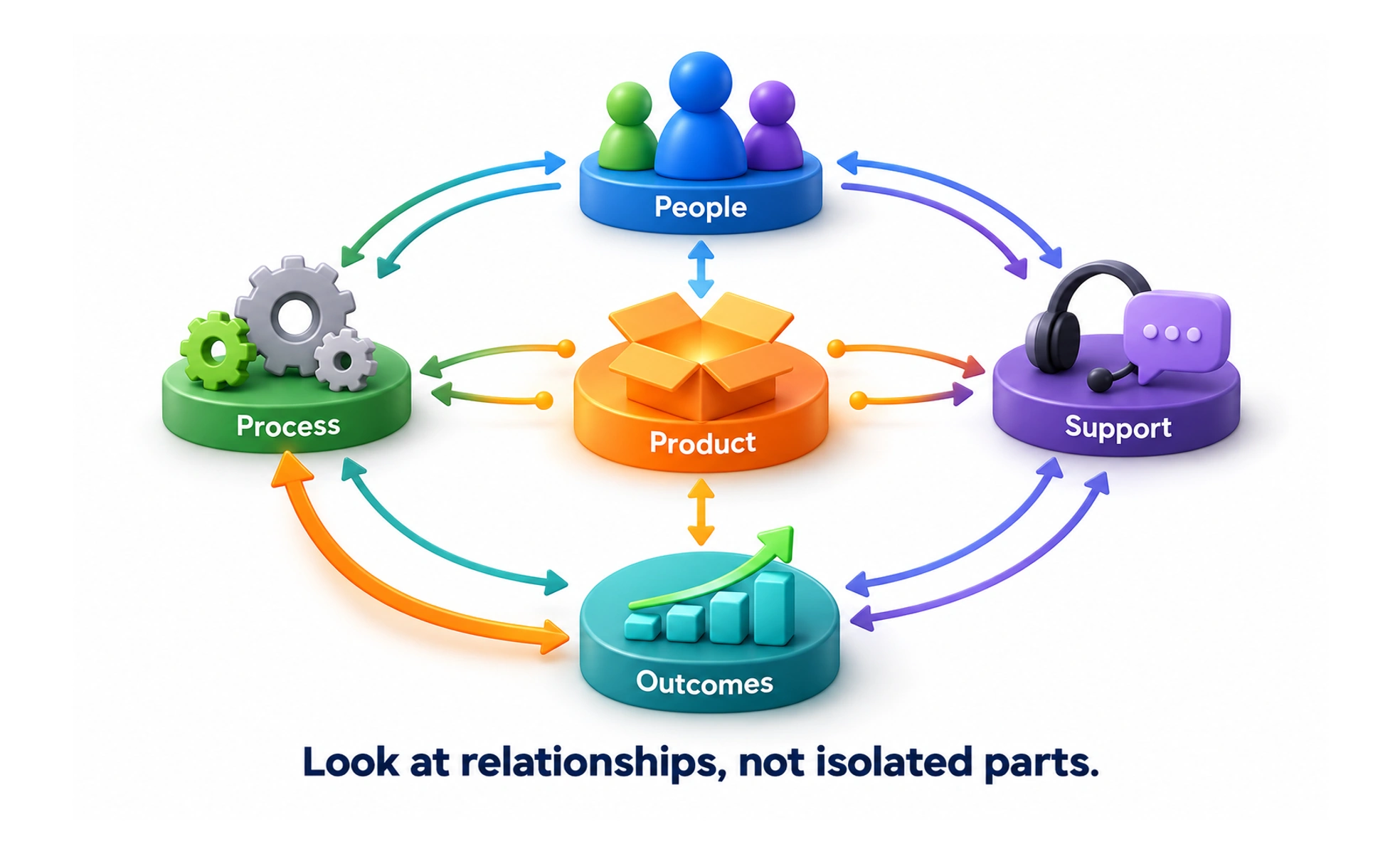
Systems thinking examines how parts of a system influence one another over time. It helps teams understand relationships, feedback, and unintended effects before changing a product or service.
Adjusting one part of a garden affects water, soil, insects, and neighboring plants. A product change can produce similarly connected effects across a service.
Look at relationships
List the people, processes, information, and technology involved in the situation. Then examine how they affect one another. A problem visible on one screen may originate in policy, incentives, or a handoff elsewhere, so fixing the surface alone may leave the cause untouched.
Consider feedback and delays
An action can change later behavior, which then influences the original situation. Some effects appear quickly, while others take time. Track these relationships so a short-term improvement does not hide a longer-term cost or lead the team to reverse a useful change too soon.
Choose boundaries deliberately
No map captures everything. Decide which relationships matter for the decision, record what is excluded, and revise the boundary when new evidence appears. A diagram is a working explanation, not a complete or objective representation of the whole world.
Example: support response speed
A team might shorten support replies to improve response time. That could increase repeat questions if the replies become less useful, creating more work later. Examining resolution quality, repeat contacts, staffing, and product issues together gives a stronger picture than optimizing response speed alone.
Frequently asked questions
Key takeaways
- Examine relationships as well as individual parts.
- Look for feedback, delays, and unintended effects.
- Make the map’s boundary explicit.
- Check whether local improvements help the wider system.