

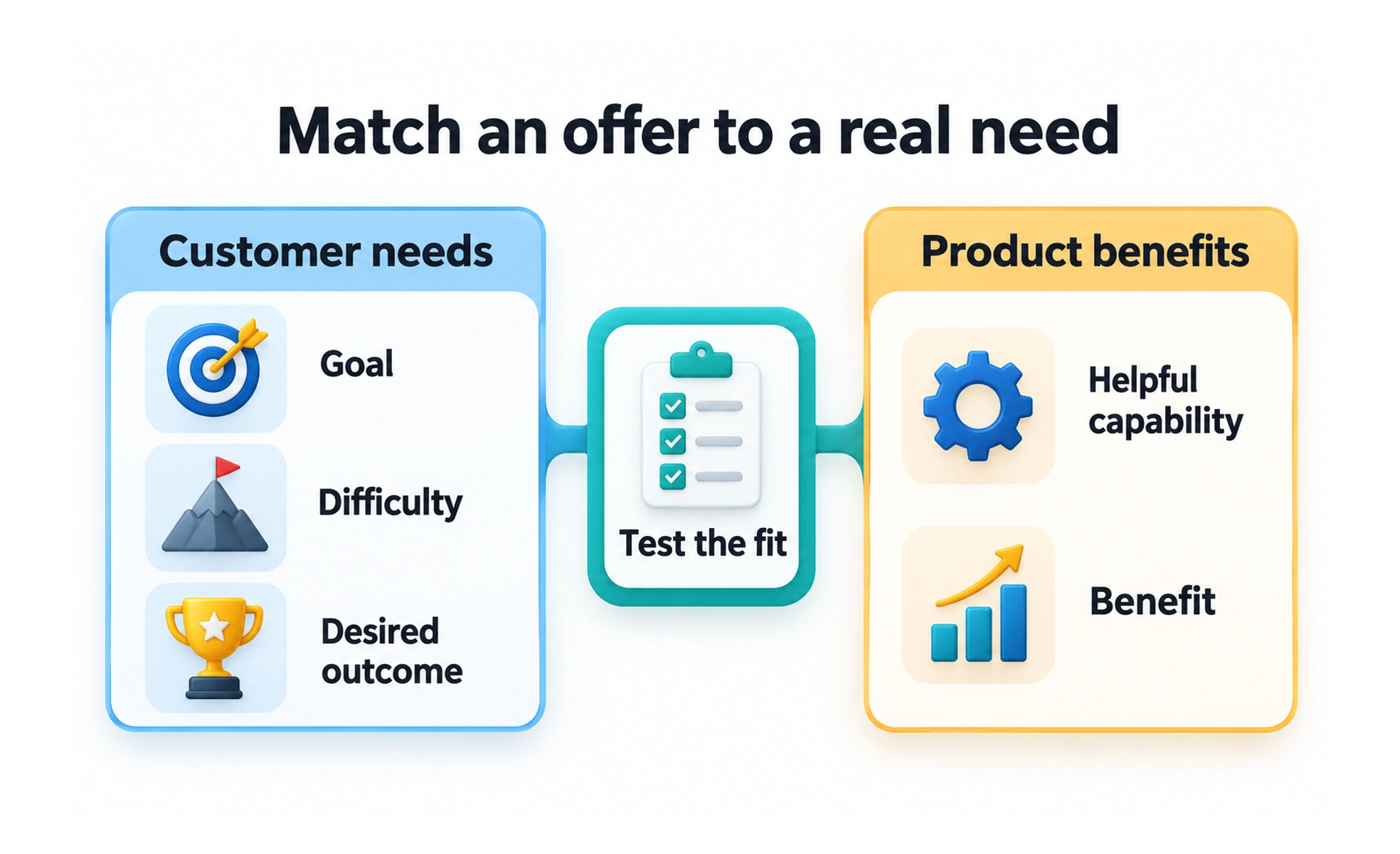
Value proposition design is the process of shaping and testing an offer around customer needs. It helps a team connect what people want to achieve with benefits the product can credibly deliver.
A tailor learns how a garment will be worn before adjusting its fit. Product teams similarly shape an offer around the situations in which people will use it.
Understand the customer’s work
Investigate what people are trying to do, what frustrates them, and what a better result would mean. Use specific accounts of real behavior to distinguish recurring needs from broad wishes. Include practical, emotional, and social considerations when they affect the decision.
Map the offer to those needs
Describe how the product could reduce important difficulties or create useful benefits. Focus on the few needs that matter most rather than claiming to address everything. A canvas or other shared artifact can organize assumptions, but filling its boxes does not establish that the offer fits.
Test both the promise and delivery
Check whether people understand and care about the proposed benefit, then whether the experience delivers it. Interviews, prototypes, landing-page experiments, and actual usage can answer different questions. State what each test can establish so interest in a message is not mistaken for lasting product value.
Example: a portfolio review service
Designers may want specific advice they can apply before an interview. A team could test whether a structured review with examples is more useful than a general rating. The offer should explain the expected feedback, turnaround, and limits, then use follow-up evidence to see whether people could act on it.
Frequently asked questions
Key takeaways
- Ground the offer in real customer situations.
- Prioritize the needs the product can serve well.
- Use shared artifacts to expose assumptions.
- Test message appeal and delivered value separately.