

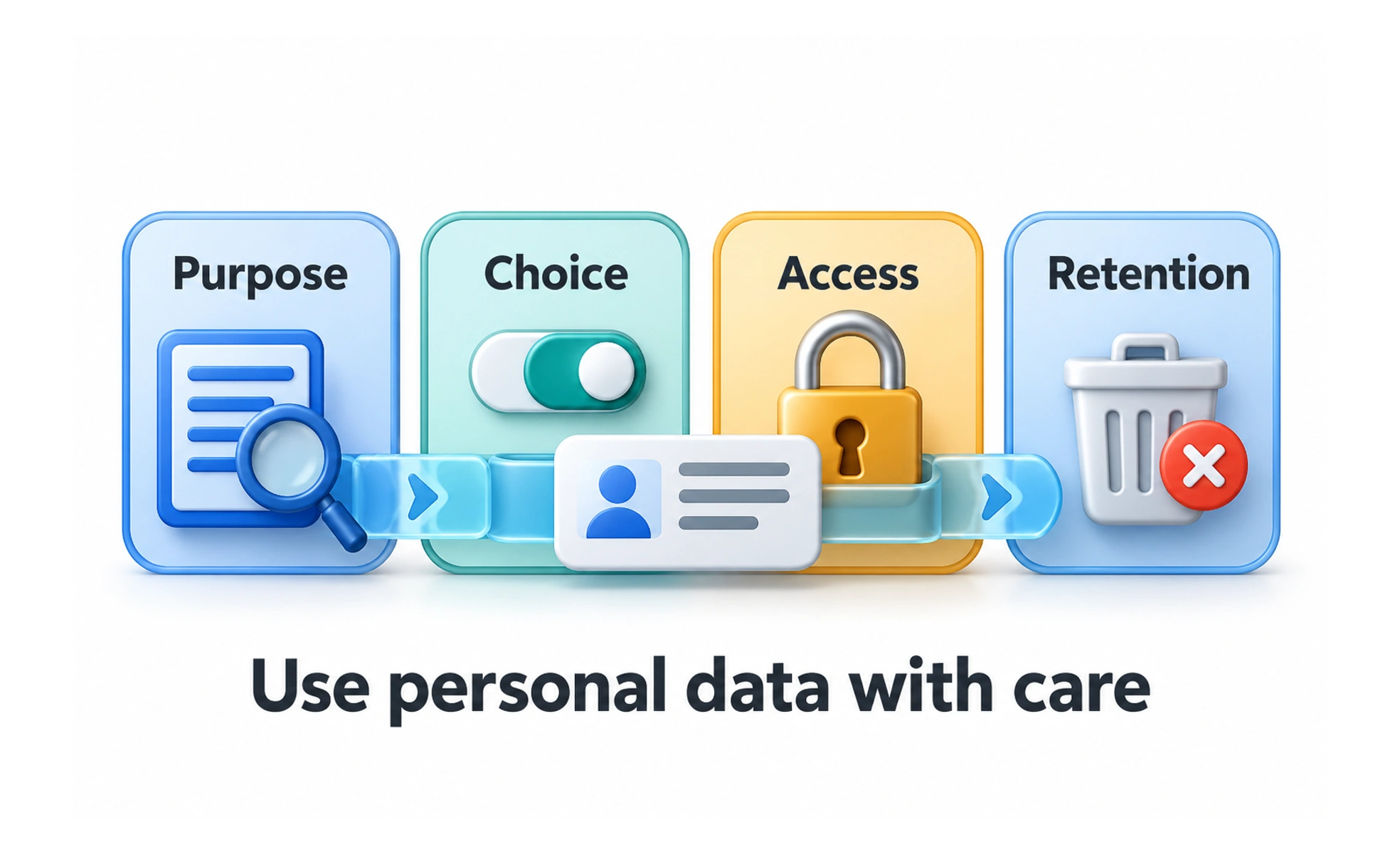
Data privacy concerns how information about people is collected, used, shared, and retained. Ethical data practice makes those choices purposeful and understandable while reducing unnecessary exposure and loss of control.
Borrowing a personal notebook for one task does not give permission to copy and distribute every page. Data use should similarly have a clear purpose and boundary.
Collect for a defined purpose
Identify what information is needed and why. Avoid collecting extra detail simply because storage is available or a future use is imaginable. Less unnecessary data means fewer opportunities for accidental exposure and fewer confusing questions for people using the service.
Explain use and meaningful control
Describe material uses in language that fits the moment, including optional analytics or communications where relevant. Controls should affect real stored behavior and persist after reload. Do not make an optional choice appear required or assume that a vague notice makes every later use appropriate.
Manage the entire data lifecycle
Consider access, sharing, retention, deletion, backups, and third-party processing. Privacy is not complete when a form has a checkbox. The system must enforce the intended boundaries, and the team needs a reliable way to honor its documented policies.
Example: a public learner profile
A learner may choose a public display name while keeping email and private assessment details restricted. Check every API and search path, not only the profile screen. Explain what becomes visible and make the effect of changing privacy settings clear and dependable.
Frequently asked questions
Key takeaways
- Collect information for specific, necessary purposes.
- Make optional choices understandable and effective.
- Manage access, sharing, retention, and deletion together.
- Verify privacy across interfaces and data paths.