

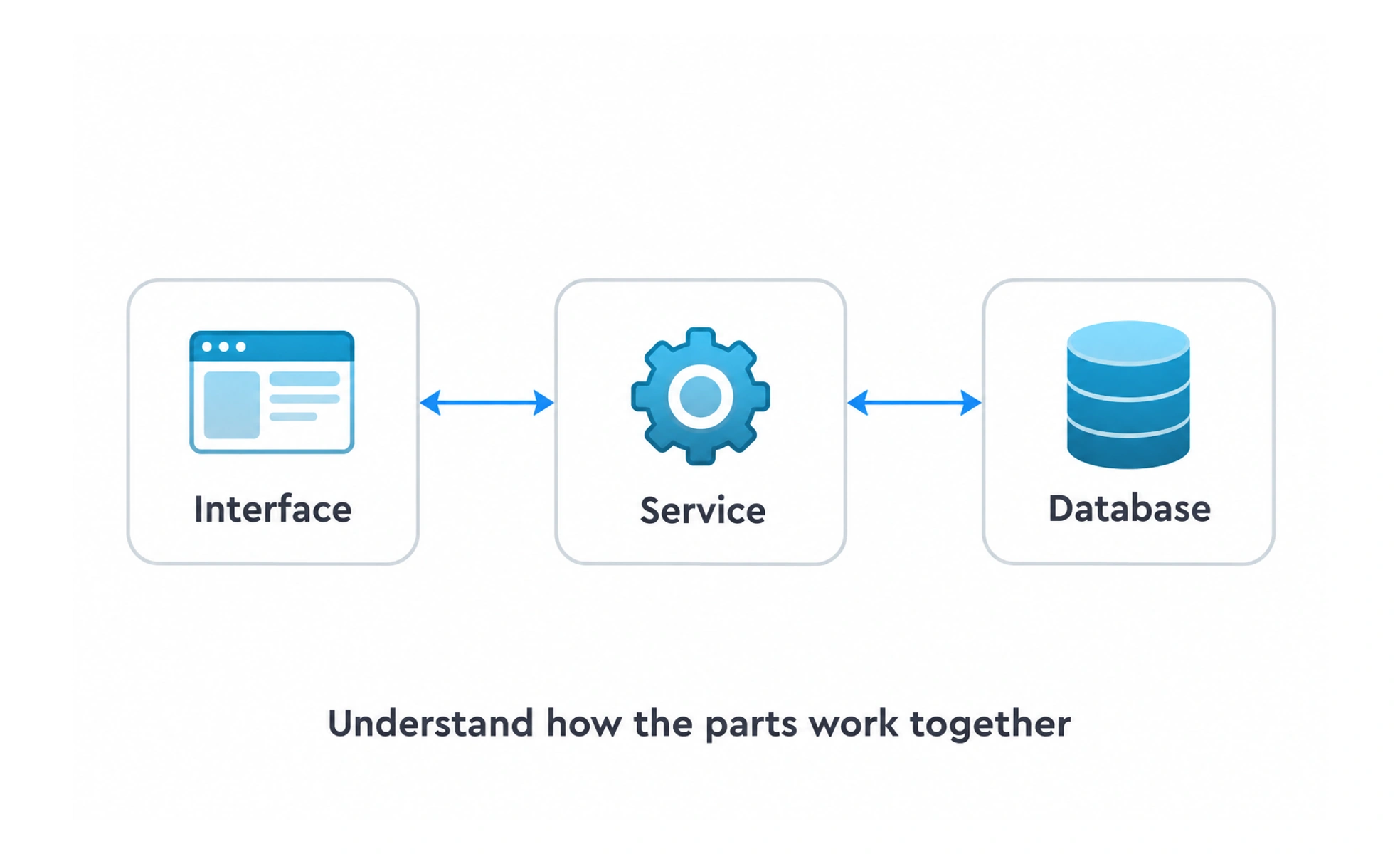
A designer does not need to build every service to ask useful technical questions. Knowing where data lives, which actions require a server and what can fail helps the team design behavior that is realistic and clear.
Understand the important boundaries
A product can include a browser interface, an application server, a database and external services. Each has a different responsibility. The browser displays and collects information; a trusted server usually enforces the rules for saved accounts and records.
Ask which part owns a decision. A button hidden in the interface is not, by itself, an access restriction. The server still needs to check whether the requested action is allowed.
Turn constraints into design questions
Technical discussions become useful when they connect a limitation with its effect on the task.
- What information can be shown before the request completes?
- What should happen if the connection drops?
- Can the action be retried without creating a duplicate?
- Which changes are saved together, and which can succeed separately?
Record the answer as product behavior, not only as an engineering note. It may change the states and explanations people need.
Example: saving a course result
The interface sends a completed attempt to the server. The server checks it, saves the result and records any eligible reward. If the learner retries after a timeout, the product should recover the same outcome instead of issuing the reward twice.
Understanding this boundary helps the designer avoid showing an unconfirmed reward or making a learner repeat a completed lesson because an acknowledgment was delayed.
Learn enough to collaborate
Use a simple system diagram and walk through one real request with an engineer. Focus on data ownership, delays, failures and trust boundaries. Ask for unfamiliar terms to be explained in the context of the task.
Avoid treating technical constraints as permanent facts without checking. Some are essential rules; others are current implementation choices that the team can improve.
Frequently asked questions
Key takeaways
- Understand how the main product parts cooperate.
- Ask where data and business decisions are owned.
- Design for delays, retries and partial failures.
- Discuss constraints through their effect on the user’s task.