Some are broadly true, like the way people group things that sit close together. Others are choices a specific team makes about what its product should favour. Both work best written down, because a principle nobody can point to cannot settle an argument.
Think of it like this. A restaurant deciding it is a family place, not a fine dining room, has answered a hundred future questions at once, from the volume of the music to whether there are crayons on the table.
Types
Visual principles govern how a layout reads before anyone starts reading.
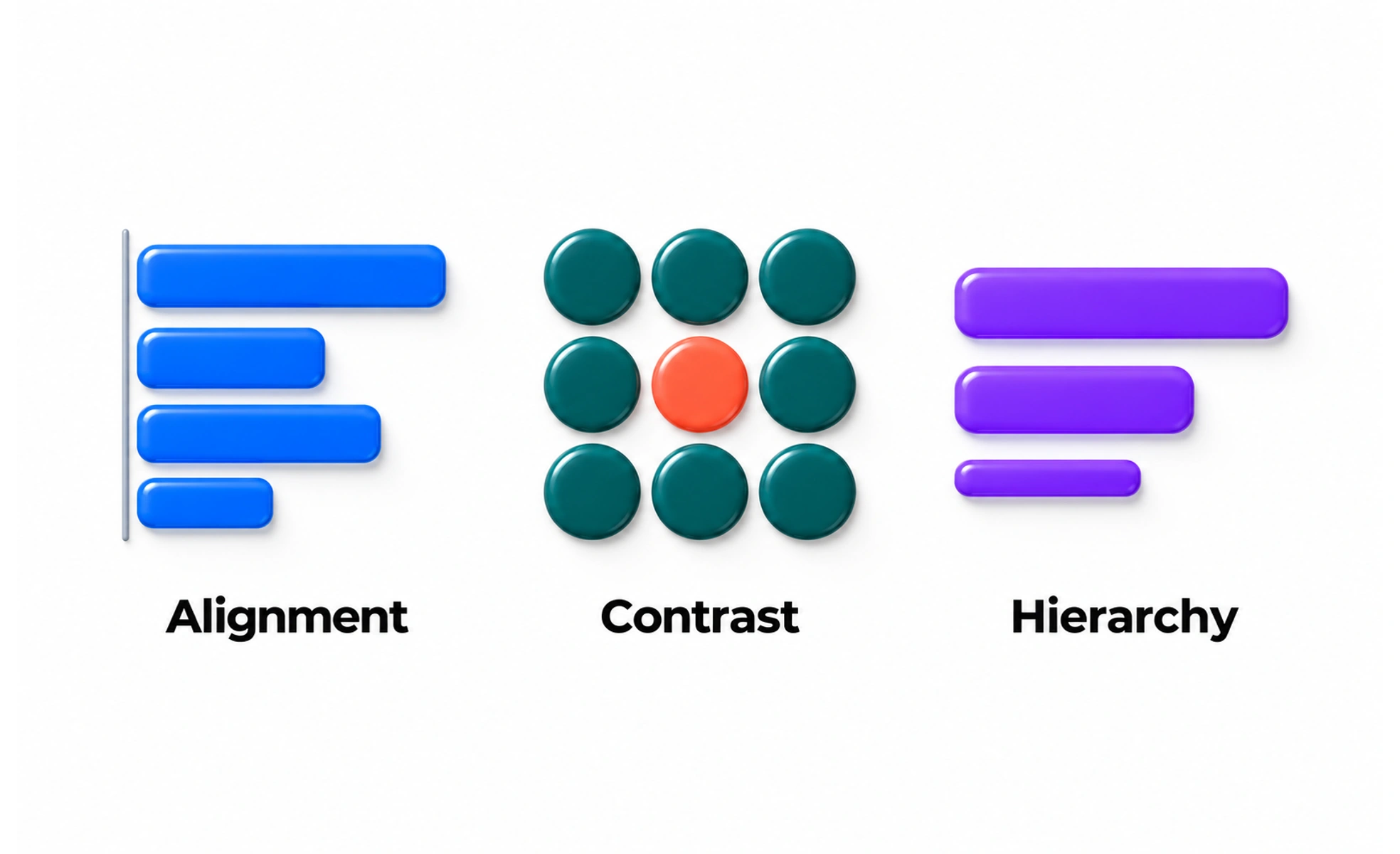
- Contrast. Difference in size, weight or colour. Creates emphasis and directs the eye.
- Alignment. Elements sharing an edge look deliberate. Being a few pixels out looks careless.
- Proximity. Things placed close together are read as related, with no label needed.
- Hierarchy. Establishes what to notice first, built from size, weight and position together.
Interaction principles govern what happens once someone acts.
- Feedback. Every action needs an acknowledgement, or people press the button again.
- Consistency. The same action behaving the same way lets people reuse what they learned.
- Forgiveness. Undo and confirmation make mistakes cheap.
How it works
Principles are directional. "Prefer clarity over cleverness" does not tell you what to build, but it tells you which of two options this product favours.
Guidelines are the specific rules underneath them: body text meets a 4.5:1 contrast ratio, touch targets are at least 44 by 44 pixels.
You need both. Principles without guidelines get applied inconsistently across a team. Guidelines without principles become rules people follow without understanding, which makes them brittle the moment an unusual case arrives.
Common mistakes
- Writing principles nobody could disagree with. "Be user friendly" cannot decide anything. A useful principle names a trade-off, so it can pick a side when two options both look defensible.
- Reinventing the well established. Adopt known usability heuristics rather than deriving your own version of "provide feedback". Save the authoring effort for choices genuinely specific to your product.
- Leaving them in a slide deck. A principle that lives where nobody works is not a principle.
Frequently asked questions
Key takeaways
- Write principles down so decisions can be argued from something shared.
- A principle that names no trade-off cannot settle anything.
- Guidelines make principles checkable. You need both.
- Prefer principles grounded in perception over principles grounded in taste.